
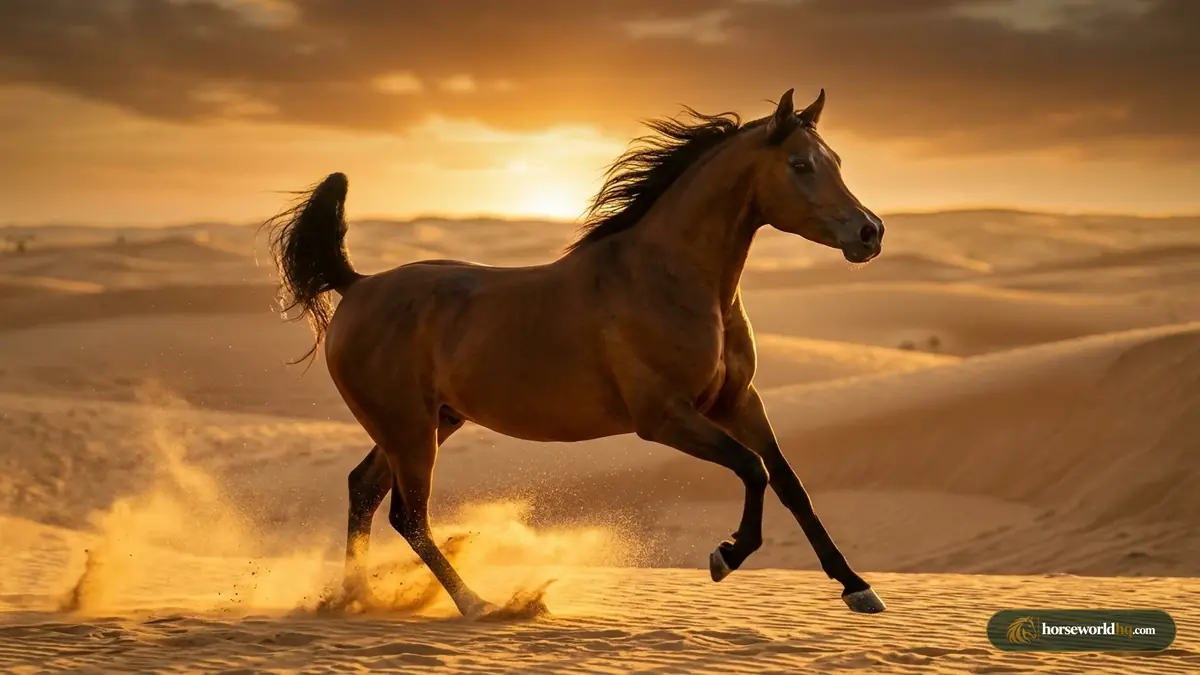
The Noble Arabian Horse: History, Conformation, Bloodlines, and Desert Heritage
 By Eleanor Hayes
*Height, weight, and traits can vary among individual horses and breeding lines.
Throughout four thousand years of documented equestrian civilization, no single breed has exerted as profound an influence on global horsemanship as the Arabian horse. Forged in the unforgiving arid deserts of the Arabian Peninsula by nomadic Bedouin tribes, this magnificent equine is revered worldwide for its sculpted dished face, prominent dark eyes, arched throatlatch (*mitbah*), proudly carried tail, and peerless aerobic endurance. More than an iconic living work of art, the Arabian represents the genetic master architect of the modern light horse, having contributed refined speed, stamina, and bone density to the English Thoroughbred, Warmblood, and American Quarter Horse. In this definitive guide, we examine the ancient Bedouin desert heritage, unique skeletal anatomy, Al Khamsa maternal strains, coat color genetics, and marathon endurance capabilities of this extraordinary equine partner.
Table of Contents
- 1. The Desert Cradle: 4,500 Years of Bedouin Horsemanship
- 2. Unique Skeletal Anatomy: The Five Vertebrae Architecture
- 3. The Al Khamsa Tradition: The Five Ancestral Bedouin Strains
- 4. Physiological Supremacy in Distance & Endurance Riding
- 5. Coat Color Genetics: Pure Solid Hues & Non-Dilute Heritage
- 6. Global Foundation Legacy: The Architects of the Modern Thoroughbred
- 7. Frequently Asked Questions About the Arabian Horse
- 8. Conclusion: The Eternal Nobility of the Arabian Horse
Above-The-Fold Al Khamsa & Foundation Sires Reference
The Classical Bedouin Strains of the Arabian Horse: Quick-Reference Guide
Short on time? Use this comprehensive reference guide to explore the five ancestral maternal strains (*Al Khamsa*) preserved by desert nomads, alongside the three historical foundation sires that transformed global equestrian sport:
| # | Strain / Sire | Physical Conformation | Temperament & Spirit | Desert Role & Legacy |
|---|---|---|---|---|
| 1 | Kehilan | Substantial bone, deep chest girth, masculine muscular frame, compact short back, broad forehead. | Fiercely courageous, highly loyal, steadfast calm under stress, powerful physical constitution. | The quintessential Bedouin warhorse; prized for brute stamina, bone density, and endurance in long desert campaigns. |
| 2 | Seglawi | Refined feminine silhouette, longer elegant neck, prominent dish (*jibbah*), lighter bone, silky hair. | Quick-witted, spirited, sensitive, energetic, affectionate, responds to gentle handling. | Celebrated for dazzling speed, beauty, and agility; heavily influential in modern halter and show ring bloodlines. |
| 3 | Abeyan | High tail carriage, pronounced arched crest, flexible throatlatch, lighter compact frame, nimble legs. | Bold, acrobatic, highly maneuverable, courageous, eager to partner with a trusted rider. | Bred for swift tactical evasions and high-speed desert raids (*ghazu*); excels today in arena versatility. |
| 4 | Hamdani | Larger athletic frame, flatter facial profile, clean dense bone, deep heart girth, long sloping shoulder. | Remarkably gentle, stoic, patient, highly observant, unshakeable mental composure. | Favored for long-distance desert migrations; the ancestral backbone of international 100-mile endurance champions. |
| 5 | Hadban | Muscular compact frame, smooth topline, strong hindquarters, refined dry head with minimal dish. | Extremely willing, friendly, bold, honest worker with rapid recovery rates. | Valued by Bedouin horsemen for rapid acceleration and unyielding stamina over treacherous rocky terrain. |
| 6 | Darley Arabian | 1700 foundation stallion; 15.0 hands, deep bay coat, white blaze and three white socks, compact power. | High-spirited, brave, unyielding athletic engine, remarkable cardiovascular volume. | Sired Flying Childers and Bartlet’s Childers; paternal ancestor of over 95% of all modern English Thoroughbreds. |
| 7 | Godolphin Arabian | 1724 desert stallion; brown-bay coat, high crest, deep ribcage, powerful sloping croup. | Fearless, intense, fiery determination, dominant masculine presence. | Sired Lath and Cade; grandfather to the legendary racehorse Matchem, establishing supreme speed and bone. |
| 8 | Byerley Turk | Captured at the Siege of Buda (1686); dark bay or brown, refined desert head, long agile stride. | Composed battle warhorse, courageous under gunfire, extraordinary stamina. | Paternal founder of the Herod Thoroughbred sireline, transmitting agility, athletic courage, and longevity. |
The Desert Cradle: 4,500 Years of Bedouin Horsemanship
Archaeological artifacts, rock carvings in the central Arabian plateau, and ancient Semitic inscriptions reveal that horses of distinct Arabian type have thrived in the Middle East for over four millennia. In the hyper-arid deserts of the Nejd and Hijaz, survival demanded physical fortitude and absolute human-equine interdependence. Nomadic Bedouin tribes regarded their horses not as livestock, but as sacred gifts (*Asil*—purebred noble creatures) entrusted to them by divine providence.
A distinctive hallmark of Bedouin breeding was the reverence for the war mare (*faras*). While European medieval warfare celebrated heavy stallions like the destriers that evolved into the Friesian horse, Bedouin warriors rode mares on lightning-fast desert raids (*ghazu*). Mares did not nicker when encountering enemy encampments, moved silently across sand dunes, and exhibited intense tactical focus in close combat.
Furthermore, the harsh desert climate forged the famous “tent horse” bond. During freezing desert nights and blinding sandstorms, prized mares were brought inside Bedouin family tents for protection, sharing dates, camel milk, and sweet water with children. Over dozens of centuries, this intimate domestic proximity culled any horse exhibiting biting, kicking, or nervous aggression, creating an equine partner world-renowned for its profound empathy, affectionate temperament, and intuitive bond with human handlers.
Unique Skeletal Anatomy: The Five Vertebrae Architecture
Beyond its ethereal beauty, the purebred Arabian possesses a well-documented anatomical variation that distinguishes it from almost all other domestic horse breeds:
Vertebral Architecture
While standard horses possess 18 pairs of ribs, 6 lumbar vertebrae, and 18 caudal (tail) vertebrae, purebred Arabians frequently exhibit a compact skeletal formula: 17 pairs of ribs, 5 lumbar vertebrae, and 16 tail vertebrae. This genetic adaptation creates a remarkably short, strong back coupled with exceptional weight-bearing capacity.
5 Lumbar Vertebrae
The Dished Face & Jibbah
The facial profile exhibits a distinctive concave curve between the forehead and muzzle. The forehead features a slight convex bulge between the eyes known as the jibbah, which expands sinus volume to cool hot desert air before it reaches the lungs. Large, wide-set dark eyes offer wide panoramic vision across sand plains.
Airway Expansion
Mitbah & Flag Tail
The throatlatch (*mitbah*) features a deep, refined arch where the windpipe enters the jowls, allowing complete flexion at the poll without compromising airway capacity during intense galloping. The tail is set high on a horizontal croup, flowing upward and outward like a proud banner in motion.
Unobstructed Flexion
The Al Khamsa Tradition: The Five Ancestral Bedouin Strains
Bedouin oral history strictly tracked pedigrees through the maternal dam line, a tradition known as Al Khamsa (“The Five”). According to ancient desert lore, during a long campaign through the desert, the Prophet Muhammad tested his herd by releasing them after days without water. As the thirsty horses galloped toward an oasis, the battle horn sounded. While most rushed to drink, five loyal mares turned back immediately to obey their master’s call. These five war mares became the matriarchs of the five foundation strains:
- Kehilan: Representing pure power, deep chests, and masculine bone. The name translates as “antimony” or “kohl,” referencing the dark skin around their eyes.
- Seglawi: Known for supreme refinement, feminine elegance, and dazzling speed across level terrain.
- Abeyan: Famous for high tail carriage, arched necks, and explosive maneuverability in rocky desert passes.
- Hamdani: Characterized by large, athletic frames, straight facial profiles, and unshakeable calm endurance over 100-mile treks.
- Hadban: Compact, powerfully muscled, and noted for gentle demeanors and rapid recovery rates.
Physiological Supremacy in Distance & Endurance Riding
In modern competitive equestrian sport, the Arabian reigns supreme in endurance riding (FEI World Endurance Championships and the grueling 100-mile Tevis Cup through the Sierra Nevada mountains). This dominance is rooted in extraordinary physiological adaptations:
- Slow-Twitch (Type I) Muscle Fiber Predominance: Arabians possess a significantly higher ratio of oxidative, fatigue-resistant Type I muscle fibers compared to sprinting breeds. These fibers burn fatty acids aerobically with minimal lactic acid accumulation.
- Superior Thermoregulation: Thin, sensitive skin, sparse coat hair, and an expansive network of superficial blood vessels allow Arabians to dissipate core body heat rapidly during intense cardiovascular exertion in desert climates.
- Superior Cardiac Efficiency: Large heart girth volume, expansive splenic red blood cell reserves, and rapid heart rate recovery allow Arabian athletes to pulse down to baseline metabolic levels within minutes of completing a 25-mile loop.
Coat Color Genetics: Pure Solid Hues & Non-Dilute Heritage
According to strict international studbook standards governed by the World Arabian Horse Organization (WAHO) and our master guide to equine coat color genetics, purebred Arabians occur in four base colors:
- Bay (approx. 40% of the breed): Ranging from golden mahogany to rich blood bay with crisp black points.
- Grey (approx. 35% of the breed): Born dark bay, chestnut, or black and progressively lightening to brilliant porcelain white or flea-bitten grey through the dominant G allele, closely paralleling the grey transitions seen in the Andalusian horse.
- Chestnut (approx. 20% of the breed): Pure phaeomelanin (e/e) shades from bright copper sorrel to deep liver chestnut, frequently accented with flaxen manes.
- True Black (approx. 5% of the breed): Rare, highly prized homozygous or heterozygous black (E/- a/a) displaying a rich eumelanin sheen.
Crucially, dilute genes (Cream, Dun, Champagne, and Silver) do not exist in purebred Arabian genetics. A horse that is visually buckskin, palomino, cremello, or grullo is genetically a part-bred or crossbred (such as an Anglo-Arabian or Half-Arabian), even if registered in a secondary division. White markings—such as blazes, stars, and socks—are common and caused by non-dilute white spotting alleles like Sabino-1.
Global Foundation Legacy: The Architects of the Modern Thoroughbred
The modern equestrian world owes its greatest performance breeds directly to seventeenth- and eighteenth-century Arabian foundation sires. In England, native mares were crossed with imported desert stallions to produce the General Stud Book, establishing the English Thoroughbred. Incredibly, over 95% of all living Thoroughbred racehorses trace their direct paternal tail-male line to one of three foundational Arabian stallions:
- The Darley Arabian (foaled 1700): Bought in Aleppo, Syria, by Thomas Darley; paternal great-great-grandsire of the undefeated racehorse Eclipse.
- The Godolphin Arabian (foaled 1724): Originating from Yemen and North Africa; grandsire to Matchem.
- The Byerley Turk (foaled c. 1680): A desert war stallion ridden by Captain Robert Byerley at the Battle of the Boyne; founder of the Herod sireline.
Beyond the racetrack, Russian breeders created the Orlov Trotter using Arabian blood; France developed the Anglo-Arabian; Austria established the Lipizzaner at Piber; and European Warmblood studbooks (Hanoverian, Trakehner, Dutch Warmblood KWPN) routinely approve purebred Arabian stallions to refine bone, stamina, and noble presence.
Frequently Asked Questions About the Arabian Horse
Why do Arabian horses have fewer ribs and vertebrae than other breeds?
−
What are the five classical Bedouin strains of Al Khamsa?
−
Why did Bedouin warriors prefer riding mares over stallions into battle?
−
Can a purebred Arabian horse ever be born palomino or buckskin?
−
Why do Arabian horses carry their tails arched high like a flag?
−
How did the Arabian horse influence the creation of the English Thoroughbred?
−
Conclusion: The Eternal Nobility of the Arabian Horse
From the wind-swept sand dunes of the Empty Quarter to the modern international endurance trails, the Arabian horse remains a living testament to thousands of years of dedicated Bedouin stewardship. With its unmistakable dished countenance, floating trot, and fierce yet gentle devotion to humans, this desert jewel continues to inspire awe and devotion across the equestrian globe.
Whether your passion lies in competing across 100-mile mountain endurance rides, presenting purebred lines in the halter arena, or simply experiencing the profound telepathic companionship of an ancient breed, the Arabian horse offers a partnership like no other. Continue expanding your equine journey across our horse breeds compendium, explore deep equestrian roots in our equine cultural traditions, and unlock the science of coat colors in our coat color genetics library.
2 Thoughts on “The Noble Arabian Horse: History, Conformation, Bloodlines, and Desert Heritage”